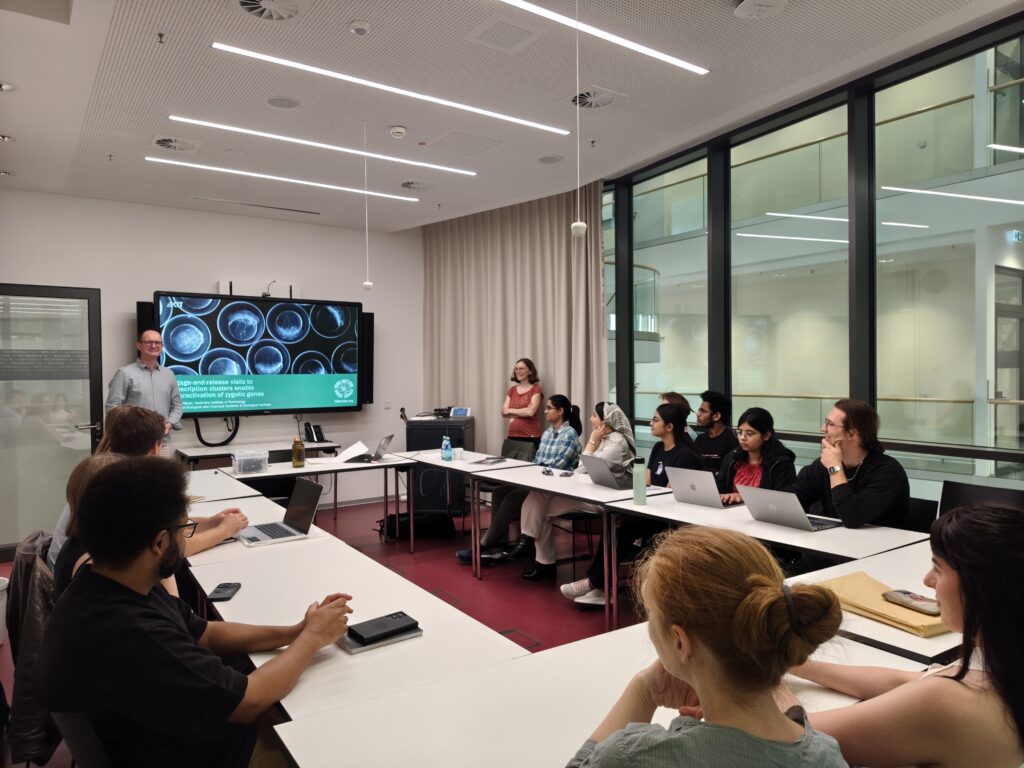

Early embryonic development requires robust changes between repression and transcriptional activation of genes. A central role in this regulation has been attributed to prominent transcriptional clusters, which are established by liquid-like condensation at super-enhancers that act as condensation surfaces. In this work, we assess how transient visits of genes to such surface condensates are related to changes in transcriptional activity over five consecutive stages of development in the early zebrafish embryo. Combining gene-specific fluorescence-labeling with automated analysis of microscopy images, we reveal that the transcriptional status of a given gene systematically maps to the frequency of spatial association of this gene with transcriptional condensates. High levels of transcriptional poising, where RNA polymerase II remains paused close to the promoter, imply frequent gene-condensate association; high levels of actual transcriptional activity imply a less frequent association, but not complete loss of association. Based on an analysis of ChIP-seq, RNA-seq, and Hi-C data, the same relation of transcriptional control and gene association with super-enhancer regions appears to hold genome-wide. These experimental observations are closely reproduced by model simulations, where a surface condensate formed on a super-enhancer region can attract and activate genes by a liquid-bridge mechanism. Finally, simulations that sample a range of “virtual gene designs” indicate two key design parameters: enhancer-like properties of the promoter region support gene-cluster association, while a high rate of transcriptional activation favors rapid detachment of the gene from the cluster. In summary, the surface condensate model explains how the transcriptional control of embryonic genes can play out via sequential engagement with transcriptional hubs followed by release upon transcriptional activation.
On behalf of SFB1551, it was a real pleasure to dive into this exciting field, which resonates so strongly with our network. We truly enjoyed the exchange and look forward to welcoming you back to Mainz soon.